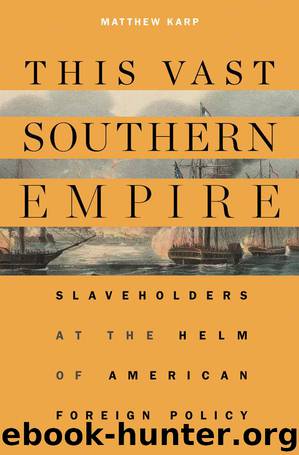
This Vast Southern Empire: Slaveholders at the Helm of American Foreign Policy by Matthew Karp
Author:Matthew Karp [Karp, Matthew]
Language: eng
Format: epub, mobi
ISBN: 9780674737259
Amazon: 0674737253
Publisher: Harvard University Press
Published: 2016-09-11T22:00:00+00:00
In its call for direct federal intervention in Cuba, the Mercury outflanked Quitman’s private plot and mirrored the battle plan recommended by no less an aggressive expansionist than Pierre Soulé.63
Amid the turmoil, there were two points of consensus in southern approaches to the Cuba crisis of the early 1850s. The first was that the security of Cuban slavery—and the existing racial order in the Gulf of Mexico—must be preserved at all costs. The second was that the United States, as the “first Republic of the world,” must be the leading guarantor of that slavery and that racial order. Even antifilibusters like the Mercury and Virginia congressman Charles Faulkner agreed that the “whole power of the Government” should be at hand to resist any attempt “to transfer the island to the black race, the necessary result of emancipation.” Cuba, in William Trescot’s European analogy, was “our Belgium.… We will assign [the island] her place.” Whether it would be a Spanish colony, an independent state, or an American province was not up to anyone else but the U.S. government to decide. And whether that decision would come in the form of a diplomatic initiative, a legalized filibuster invasion, or direct federal action was, ultimately, not a question of strategy but of mere tactics.64
As it happened, the Pierce administration veered uncertainly among all these tactical options, settling on little and achieving less. Pierce first tacitly countenanced Quitman’s military preparations and then, in the late spring of 1854, turned against them. The president’s May 31 proclamation against filibustering, together with the government’s subsequent prosecution of Quitman and two associates in June, has frequently been interpreted as the product of Pierce’s political exhaustion after the Kansas-Nebraska battles. Having already stretched his northern Democratic allies to the limits of their political lives to protect slavery in Kansas, the president could not ask for their help in safeguarding bound labor in Cuba.65
Domestic political weakness was surely part of the equation, but there were also plenty of good foreign policy reasons for even the most proslavery president to shrink from a filibuster invasion of Cuba. Although the threat of sudden American force might prove useful in negotiations with Spain, the reality of racial warfare was not nearly so appealing or such a beneficial outcome for the security of hemispheric slavery. Nor did opposition to filibustering require an American strategic retreat from the Caribbean. Even as a federal prosecutor issued charges against Quitman in a Louisiana court, Pierce, Slidell, Davis, and Mason determined that Secretary Marcy should inform the New Orleans district attorney that the United States still planned to take “immediate and decisive” measures toward Cuba. Secretary of the Navy James Dobbin, expressing the administration’s confidence in a more prudent government solution to the crisis, told a Mississippi friend that “if the Filibusters do not spoil things the Island will be ours in twelve months.”66 In Havana the passing of the filibuster threat in early 1855 prompted a sigh of relief from consul Robertson. Quitman’s withdrawal, he noted,
Download
This Vast Southern Empire: Slaveholders at the Helm of American Foreign Policy by Matthew Karp.mobi
This site does not store any files on its server. We only index and link to content provided by other sites. Please contact the content providers to delete copyright contents if any and email us, we'll remove relevant links or contents immediately.
| Anthropology | Archaeology |
| Philosophy | Politics & Government |
| Social Sciences | Sociology |
| Women's Studies |
The Secret History by Donna Tartt(19002)
The Social Justice Warrior Handbook by Lisa De Pasquale(12177)
Thirteen Reasons Why by Jay Asher(8874)
This Is How You Lose Her by Junot Diaz(6857)
Weapons of Math Destruction by Cathy O'Neil(6249)
Zero to One by Peter Thiel(5768)
Beartown by Fredrik Backman(5718)
The Myth of the Strong Leader by Archie Brown(5482)
The Fire Next Time by James Baldwin(5409)
How Democracies Die by Steven Levitsky & Daniel Ziblatt(5200)
Promise Me, Dad by Joe Biden(5132)
Stone's Rules by Roger Stone(5065)
A Higher Loyalty: Truth, Lies, and Leadership by James Comey(4937)
100 Deadly Skills by Clint Emerson(4900)
Rise and Kill First by Ronen Bergman(4761)
Secrecy World by Jake Bernstein(4727)
The David Icke Guide to the Global Conspiracy (and how to end it) by David Icke(4685)
The Farm by Tom Rob Smith(4489)
The Doomsday Machine by Daniel Ellsberg(4474)
